
Earlier, repression used to be heavy in areas where class struggle was intensifying, but relatively low in areas where class struggle was less. While secret methods, and illegal struggle methods had to be adopted in the areas of intense conflict, semi-legal methods and open militant struggles were going on in the other areas. But from mid 1985 the scale of repression took a qualitative turn - it was an all-out attack on the party. The massive onslaught called for new political, organisational and military initiatives.
In mid-1985 the government virtually began an undeclared war on the revolutionary movement. By May 1985 eleven comrades had been killed in fake encounters. Earlier, while separate incidents of 'encounters' took place, now it was taken as a systematic method of elimination of organisers. The offensive now, was launched against the masses, against the party and against every field of the mass movement. The state police began a campaign of terror in the villages, by launching sudden raids on villages and torturing any youth who fell into their hands; razing to the ground the houses of party organisers, of their relatives and of militant sangam leaders; destroying their crops and property; and beating people enmasse. Police officers upto DIG level were personally directing the campaign. Any organiser apprehended was immediately shot dead. If people were spotted in the fields after dark the police could fire indiscriminately. Section 144 was imposed in the entire rural tracts of North Telangana. A huge network of police informers was established in the villages and patrolling by vehicle and foot was intensified. The police armed the landlords and their goondas and encouraged them to attack the masses. They resorted to torturing and humiliating the innocent masses on the pretext that they give food to the party organisers. They also began a big propaganda campaign against the party through hand bills, wall posters and cultural programmes. They brutally attacked those seeking to attend the 3rd State Conference of the RCS, raided the office of 'Kranti' (official organ of the AP PC) and the bookshop, Peace Book Centre. Mere reading of 'Kranti' or a handbill or even listening to a cassette of a revolutionary song was sufficient to lead to arrest and possible torture. They formed village volunteer squads with landlord's hoodlums and forced villagers to patrol in the nights and attempted to get minute details of the movement through their stooges. Warangal town was virtually under police occupation, with police camps becoming centres of barbaric tortures and vulgar humiliations.
Comrade Meghyam hung by electric pole - Warangal police excel in sadism.
Simultaneously, the district collector, the DSP and Zilla parishad presidents jointly conducted 'Peoples Durbars' and deceptive reform schemes in the name of 'rehabilitation of radicals'.
In the face of this terror the party had to devise new tactics. But this got delayed by the crisis precipitated in the Central Committee by the SM VS clique. Using 'left' sounding phraseology this clique sought to derail the general line of the party by introducing a liquidationist line through opportunist and conspiratorial methods. Though the vigilance of the party could defeat this line, it came at the same time as the enemy attack from outside. Yet, in a special meeting in May 1985, while fighting the opportunism within the party, tasks were formulated for countering the enemy's offensive. From this meeting a circular was issued entitled "Let us defeat the enemy's offensive..." which called for a defensive war to preserve the forces and thereby advance the movement.
In order to face the new offensive the major focus was to, enhance the defence capabilities, build secret mass organisations and begin retaliations against the police force..........particularly notorious officers.
In order to implement these new policies in the field, there was need to further develop the CO structures and the combat preparedness of the squads. In order to do so the CO's area of operation was widened in order to allow for greater manouverability, and the number in each group, increased. The squads were now to follow stricter military methods, use military formations and more secret methods of movement. Their numbers were to be increased to nine.
The mass organisations were now to be developed with the leadership totally underground and even its membership was to be semi-legal.
Till now the chief attacks had been confined to landlords and informers. With the decision to attack the state forces, the movement would move to a higher stage.
With these steps the party sought to fight back the enemy offensive and regain the initiative in the war of self-defence.
As Mao said, links between the communists and the masses is like that between fish and water. Take a fish out of water, it is easy to kill. To separate the guerilla fighter from the masses is the main aim of the mass repression campaign....it then becomes easy for the state to isolate the guerillas and crush them.
Invariably, when the police launch their mass terror the people, at first, get frightened. Very often they will even stop giving food for fear of police action. After the 1985 terror, under these severe conditions, with intense combing operations, the squads some time could not get any food. In some places, of course, the people did use ingenious methods to somehow reach food to the squads. But in many other areas, out of fear, they would hesitate. The squads had somehow to win back their confidence and give them courage to fight back. In some instances they would even solicit food taking a towel from house to house - at night. People would get shocked to see their 'Annas' in this condition. Though frightened, with tears in their eyes they would give food, first secretly..... after a few weeks the people would muster courage and even invite them back to their houses.
At such times, the main task was to somehow maintain contacts with the masses, without falling into the trap of the enemy. The times were very trying, but with patience and Bolshevik determination, the people were won back. Moreover, having faced repression, they were better steeled for future struggles.
From 1985 to May 1987, repression gained the upper hand, and to some extent, passivity set into the people's movements. The movement suffered particularly in the towns. But even in this period the tendu-wage struggle continued and so did the struggle for the reduction of arrack (liquor) prices. In some areas Panchayats were held.....now secretly. Secret propaganda was conducted on a wide scale.....and during this period a number of the most cruel landlords and police informers were annihilated.
The party utilised this period to consolidate itself. Detailed discussions were held at CO level and DC level on work methods during repression and on rectification. In addition, political classes were held all over the state. In this process, district plenums were held and the practice and crisis in the party were reviewed and, later, the 13th State Conference of the AP unit of the Party was successfully concluded in May 1987.
The May 85 special meeting had resolved to take action against specific officers with a notorious reputation. The first few attempts failed, as the squads which had skill in attacking landlords and their stooges were not that confident before well-armed and well-trained police personnel, that too in urban centres But, as Mao says, we learn warfare through warfare. In August 1985 the SI, Laxman Rao was annihilated and in the next month, the demon incarnate, SI Yadagiri Reddy was finished off on the platform of Kazipet railway station. But, with this action the police went on a rampage in Warangal town and like beasts attacked all and sundry. In this mayhem they shot dead the renowned Civil Rights leader and people's doctor, Ramanadham. The next day, at Dr. Ramanadham's funeral, thousands attended, and many wept uncontrollably, including the wives and children of some policemen, who had received selfless treatment from their doctor.
Through 1986 and 87 the squads' initiative increased, and incidents occurred of squads, not only attacking the police, but now, even seizing their weapons. On November 6, 1986, the notorious butcher of Peddapally, DSP Butchi Reddy was annihilated in his own office and his sten gun seized. Again the police retaliated and killed Advocate Japa Lakshma Reddy, the respected leader of the Karimnagar district Civil Rights movement. In 1987 the attacks increased. In July two policemen were ambushed and killed in the East Division; in the same month six policemen were ambushed and killed and six rifles and ammunition seized. In August 87 two SIs and eight policemen were killed in an ambush m Adilabad district, five rifles, four muskets and one 0.45 revolver seized; in October 87 a squad raided a magazine guard in Karimnagar district, killed one policeman, wounded two and seized five rifles. In February 1988 the notorious CI Linga Reddy was annihilated in Nizamabad district. At Rajura in Chandrapur district, the enemy was lured into an ambush. Slowly, the military level of the Party grew.
In addition two military camps in 1987 and 1989 improved the military knowledge of the squads and village militants.
From 1988, though the repression continued, people conducted large-scale protest struggles, in the form of destruction of government properties through clandestine actions and by facing the police, using a variety of methods. Having had to bare three years of repression, the peoples' anger burst out in a wave of protests, that lasted six months. In the resistance upsurge government offices, banks, microwave stations, railway stations, mandal offices, godowns etc....were all reduced to ashes in the fire of people's rage.
This resistance was taking place in the midst of stepped up encounter killings. From 1988, in a systematic campaign, the police went on a killing spree, selectively killing sangam leaders, party sympathisers and common people with active links with the revolutionary movement. In 1986 alone, 63 comrades were shot dead while some others were abducted and are 'missing' till today. In May 1988 they murdered Daggu Rayalingu, the Karimnagar party district committee secretary and also a member of the North Telangana Regional Committee. In December 1988, the secretary of the North Telangana Regional Committee, Ilaiah, was arrested and has been 'missing' since. Also the Singareni committee member, Mekala Narasaiah was shot dead in broad day light in Godavarikhani.
By October 1988, thousands of peasants were once again being mobilised against the worsening famine conditions. In North Telangana (NT) for a full year 'famine raids' were conducted on the houses and granaries of big merchants and landlords. More than ten thousand adivasi men and women participated in these raids. Along with these 'famine raids' famine relief committees under the leadership of the RCS were set up. Rice, sorghum, wheat, chilli powder and cash worth Rs 20 lakhs were collected from big merchants. This was distributed to 180 villages. In Dandakaranya (DK) too a 'famine aid committee' was formed under the RCS. This collected more than 50 lakh rupees of donations and paddy. Through these famine raids, and the resulting police repression, the organised resistance of the masses in Dandakaranya grew, and resulted in the formation and strengthening of the village defence squads.
In the NT rural areas the anti-arrack struggles once again picked up momentum when the masses smashed arrack depots and attacked contractors. In the urban areas, though the student and youth had been badly affected by 'encounter' killings, the revolutionary writers and intellectuals displayed immense courage in lending full support to the movement. The RWA and JNM conducted extensive propaganda through a variety of literary forms, in support of the struggles. They not only inspired the people of Telangana through their writings, they also gathered the support of people from other areas. The civil liberties organisation (APCLC) and other democratic intellectuals, put in enormous efforts fighting legal battles, exposing 'fake' encounters through fact finding reports, issuing statements, etc. They helped arouse the conscience of the people. For this, they too faced the wrath of the police - civil liberties leaders, Gopi Rajanna, Japa Laxma Reddy and Dr. Ramanadham paid for their dedicated work, with their lives.
In addition to all the earlier types of struggle like tendu leaf etc, various new forms of struggle and resistance came into existence during this period, the most significant being - the celebration of Martyrs' Day, the 'Work Day' in Gadchiroli and the kidnappings in AP.
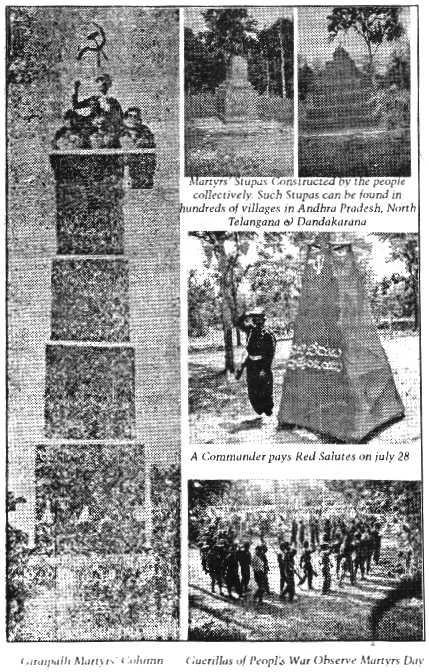
The party decided to observe July 28, the day Charu Mazumdar was martyred, as Martyrs' Day every year. On July 28, 1989 memorial meetings were held all over AP and Dandakaranya. In villages all over the countryside, meetings and processions, ranging from 50 to 5000 were held, and memorial columns erected in memory of those who laid down their lives. The people put in their own labour, money and gathered whatever they could to build the 'stupas' as a memorial to the martyrs.
In 1987 the Party took a decision that a campaign should be conducted to collect party funds from the people. In Gadchiroli the party called upon people to work one day, during the bamboo season, exclusively for the party. Thus the 'Work Day' was evolved and developed, out of the application of the mass line by the Gadchiroli comrades.... This developed, not merely as a means of fund collection, but as a powerful mass movement. In the first 'Work Day' experiment some 6000 people participated, together with the squad members. The collection was Rs 60,000. After the first experience the party did a systematic review, outlined the short-comings in the campaign, the ideological weaknesses and suggested improvements for the next year. This year the police launched big attacks and two squads narrowly escaped. In future the 'Work Days' were conducted secretly. Each year the participation in the 'Work Day grew and by 1993 the collection was 24 lakh rupees.
After the disappearance of Ilaiah it was decided to take hostage politicians belonging to the ruling party and demand the release of comrades. The president of Tadicherla Mandal (Karimnagar district) was kidnapped and the release of the abducted comrades demanded. When this was not acceded to, he was killed. This was followed by a spate of kidnappings....this sent panic into the Telugu Desam party leaders who began putting pressure on their own government to stop 'disappearances' and 'encounter' killings.
By the end of 1989 the movement had regained the initiative and with the experience of the past five years of working in repressive conditions, it was possible to hold secret meetings ranging anywhere from one hundred to one thousand participants. The movement had taken yet another step forward, it had gone to a higher stage.
Next Page Prev Page Contents Main index India section Search